Saturday, September 24, 2011

Jesus' Response to the Pergumists


Wage war—Jesus will wage war on his enemies.  Jesus is saying to the church to be careful not to put themselves in the enemies’ camp.  By participating in emperor worship, one would be forsaking Jesus (unlike Antipas) and standing with Jesus’ enemies instead.

Hidden manna—Manna is the provision of God for Israel in the wilderness.  It is secret or hidden because for now it is unseen—it probably symbolizes the kingdom of God to come.  This manna, given by God, is in opposition to the meat of idolatry mentioned earlier.

White stone—The white stone is given to one who is acquitted.  Jesus is acquitting his church—though they have compromised with the world, nevertheless He is granting them pardon if they would but repent.


Sexual Immorality In Revelation


The Greek word, pornea is translated "sexual immorality" and sometimes "adultery."  It occasionally is in scripture used as a symbol for worshipping other gods.  John is probably warning the church not to participate in any kind of idol worship here.  In Pergamum, it would be easy for them to take part in emperor worship, in addition to Christian practice.  But Jesus strongly warns them not to take part in it.

Eating Meat Sacrificed To Idols

Could I have some of that smoked salmon up front?


Meat sold in the marketplace was often offered to idols first.  There was an early Christian (and Jewish) debate whether one should eat meat in the market or not.  Jewish scholars eventually emphasized “kosher” or rabbinicly approved food.  But most Jews (and Christians) went one of two ways—re-blessing the food or refraining from all meat. 


Paul said that on the surface either way was fine, but that those who “re-blessed” shouldn’t cause those of the other group to sin by encouraging them to eat the meat (I Corinthians 8-10; Romans 14).  John is clearly of the other group, not wanting the people of God to be impure by taking part in idol worship.

Balaam


All you ever needed to know about Balaam is right here in this song. 

He was a prophet of Yahweh in the time of Moses.  He was paid to curse Israel, but he only blessed Israel instead. (Numbers 22-24)  The text suggests, and later stories spell out, that Balaam taught Barak, the king of the Moabites, how to defeat the Israelites—to have his young women seduce the young men of Israel and convince them to worship other gods. (Numbers 31:13-18)  Balaam was eventually killed by the Israelite army. (Numbers 31:8).  In the Jude tradition, Balaam became a byword for a teacher of God who does so for personal profit (Jude 1:11; II Peter 2:15).

In Revelation, Balaam is a picture of a prophet who knows just enough truth to be dangerous and uses that knowledge to draw people into idolatry.  At the time of writing, there were people teaching Christians that it is okay to give into worshiping Caesar... add Christian excuse after.  "God will always forgive you after."  "You need to get along in the world."  "Sometimes a compromise is the best."

Friday, September 23, 2011

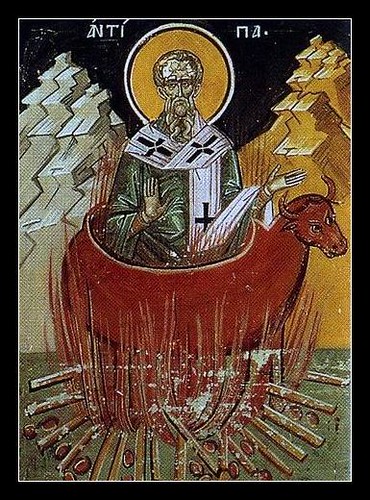
Martyr of Pergamum


An icon of Antipas of Pergamum 

Antipas—We know nothing of him apart from the information in Revelation.  Only that he was a martyr for Jesus’ faith, that he stood by Jesus even though threatened.  It was common in the second century for Christians to be forced to choose between emperor worship and their faith in Jesus.

There are a number of later traditions written about Antipas. It is said he was told, "The world is against you, Antipas"  He is said to have responded, "Then I am against the world!"  You can read a fuller story about Antipas here.

My witness, my faithful one—These titles spoken about Antipas are the same titles as given to Jesus in chapter one.  “Witness” in Revelation is the word “martus” from which we gain the word “martyr”.  The book of Revelation is the book that began the use of "martus" for one who dies for his faith.

Satan's Throne

There are two strong possibilities for what "Satan's throne" was in Pergamum.

1. The Temple of Zeus

There was a huge and famous temple of Zeus in Pergamum (the photo above is a reconstruction of the Western side of this temple).  The question would be, how would Zeus be seen as Satan?  Satan is often associated with Baal, the Canaanite god of war and thunder, who defeated El, the Father God, to rule over heaven and earth.  Zeus is the Greek counterpart to Baal, a god of thunder, who defeated his father, Saturn, to rule over heaven and earth.  In the creation story of Genesis 1, El reorganizes heaven and earth to restore it to his possession after the powers of darkness and water had taken over.

As all three personas are seen as pretty much the same, Satan's throne could be seen as Zeus' largest temple in the Roman empire.


2. Emperor worship

Pergamum was also famous as being a center of emperor worship.  In the first century B.C. they would hold processions for Augustus, the first emperor of Rome.  This worship grew through the time of Trajan in the early second century A.D., where Pergamum was the capital of its province in Asia and was the focus of emperor worship in Asia.

How would emperor worship be seen as the "throne of Satan"?  The Roman persecution of Christians would be seen as an act of judgment on the innocent, and thus an act of Satan, the "prosecutor" and the "accuser of the brothers."  Worship is a symbolic act of reverence to a powerful emperor, whether a god or a man.  Thus, the center of worship is a kind of throne of an emperor.   So emperor worship could be considered "Satan's throne".

F.F. Bruce on emperor worship in Pergamum

Cuts Both Ways


Jesus emphasizes that he has a two edged sword to the church of Pergamum. This is a sword that cuts two ways and is used both for defense and attack.  In the context of a church that has a group of heretics, Jesus is probably saying that he could use it either way for the church.  He could defend them in their time of need, when being attacked, or he could judge them if they remain on the side of compromise.